The Ripple Effects of Blackjack Rule Changes on Strategies in Online Bingo
Written by Yves Jung · Aug 5, 2026

The Ripple Effects of Blackjack Rule Changes on Strategies in Online Bingo
Blackjack tables operate under sets of rules that shift from one venue to another, and those shifts alter basic strategy charts in measurable ways. Single-deck games with dealer standing on soft seventeen reduce the house edge by roughly 0.2 percent compared with multi-deck setups where the dealer hits soft seventeen, according to figures published by the Nevada Gaming Control Board. Players who internalize these differences often carry the same probability mindset into bingo rooms, where number selection and pattern completion also hinge on combinatorial odds rather than pure chance.
Core Rule Variations and Their Statistical Footprint
Rules governing doubling after splits, surrender options, and the number of decks in play create distinct decision trees. A game that permits doubling on any two cards and resplitting aces lowers the house edge by an additional 0.08 percent, data compiled by the University of Nevada, Las Vegas International Gaming Institute shows. Observers note that participants who track these adjustments become accustomed to recalibrating expectations mid-session, a habit that surfaces again when bingo players evaluate ticket packs or decide whether to join progressive jackpots.
Conversely, continuous-shuffle machines eliminate card-counting opportunities and compress the window for strategic deviation. Research from the Canadian Centre for Gaming Research indicates that such machines increase the effective house edge by 0.5 to 1 percent in blackjack, prompting players to tighten bet spreads or shorten session length. The same discipline appears in bingo environments when operators introduce rapid-fire variants that compress draw intervals and reduce the time available for pattern analysis.
Transfer of Decision Frameworks
Those who study blackjack rule sheets learn to weigh multiple variables simultaneously: remaining deck composition, dealer upcard, and current bankroll allocation. Bingo software frequently presents similar multivariate choices through features such as auto-daub, ticket stacking, and side bets on pattern completion. Players accustomed to adjusting blackjack strategy for rule sets often apply parallel logic when deciding how many cards to purchase or whether to chase a specific pattern under time pressure.
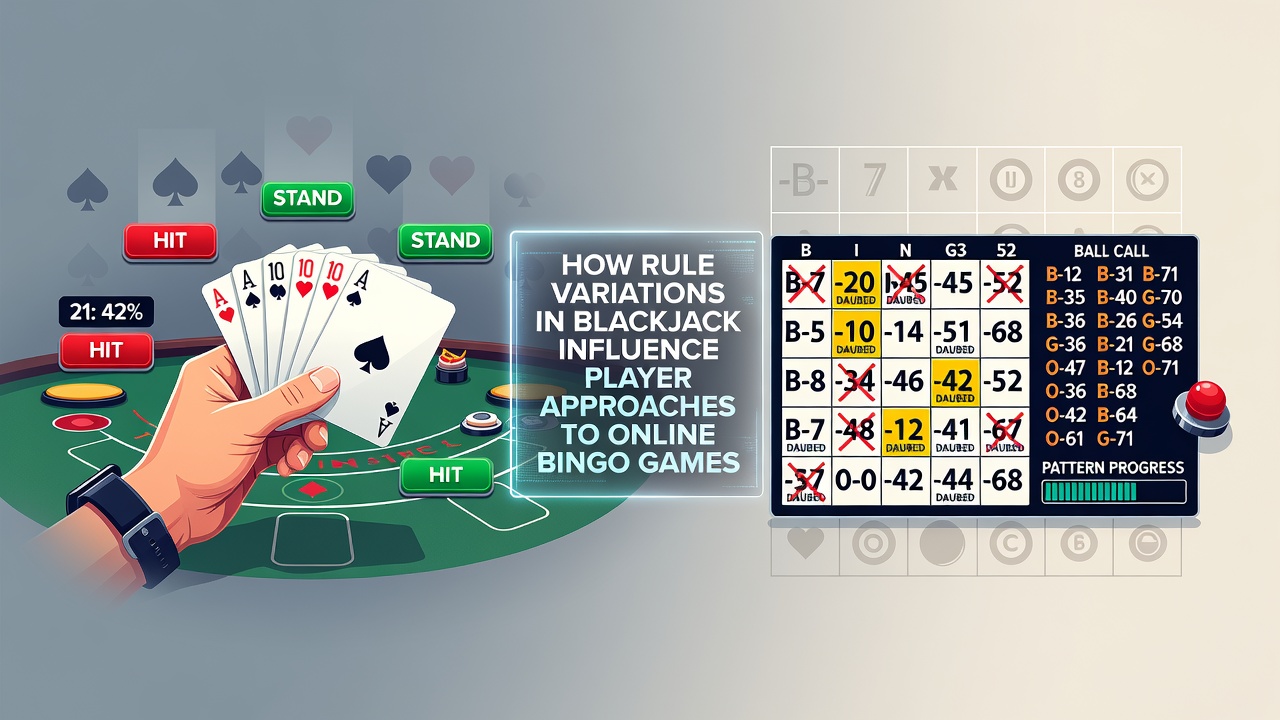
Take the case of surrender rules. A game allowing late surrender reduces losses on weak hands by approximately 0.08 percent per hand, according to calculations released by the Australian Institute of Gambling Research in August 2026. Players who routinely apply this option develop an early-exit mindset. In bingo rooms the equivalent behavior manifests as abandoning a low-probability ticket mid-round rather than committing additional stakes to chase diminishing returns.
Bankroll Management Patterns
Blackjack sessions governed by stricter rules encourage smaller unit bets and more frequent breaks. Data released by the New Jersey Division of Gaming Enforcement in 2025 revealed that average bet sizes dropped 12 percent on tables with unfavorable rules compared with player-friendly variants. Bingo participants who migrate from such blackjack environments frequently adopt similar staking discipline, purchasing fewer tickets per game or spacing purchases across multiple draws rather than committing large sums at once.
Rule variations also affect session duration. Games with continuous shuffling tend to produce shorter average play times because the absence of counting opportunities removes incentive for extended observation. Bingo operators report parallel behavior when rapid-draw formats replace traditional 90-ball sequences, with session logs showing players rotating through multiple short rooms instead of lingering in a single long game.
Psychological Carryover and Pattern Recognition
Regular exposure to blackjack decision matrices strengthens pattern-recognition skills. Researchers at the University of Macau documented improved performance on combinatorial tasks among participants who practiced blackjack strategy for eight weeks. Those same cognitive habits surface when bingo players scan grids for emerging patterns, especially in 75-ball variants that reward multiple winning configurations within a single draw sequence.
Rule changes that increase variance, such as six-to-five blackjack payouts, train players to tolerate larger swings. Industry reports from the South African Responsible Gambling Foundation note corresponding increases in high-volatility bingo ticket selections among cross-game participants. The reverse holds when blackjack rules favor the player: lower-volatility betting patterns tend to transfer into bingo rooms that emphasize steady, smaller wins over jackpot chases.
Conclusion
Rule variations in blackjack supply a training ground for probabilistic thinking that players later apply to bingo mechanics. Statistical adjustments in one game alter bet sizing, session length, and exit strategies in the other. Data from multiple regulatory and academic sources confirm measurable behavioral transfer, demonstrating that familiarity with blackjack rule sets shapes concrete decisions inside online bingo environments without requiring direct instruction.