Primes and Pip Counts: Mathematical Edges Shaping UK Online Backgammon Battles
Written by Yves Jung · Apr 7, 2026

Primes and Pip Counts: Mathematical Edges Shaping UK Online Backgammon Battles
Backgammon Basics and the Rise of Online Play in the UK
Backgammon, that ancient board game blending luck with sharp strategy, thrives in UK online arenas where players chase mathematical advantages night after night; platforms report surges in participation, especially as April 2026 tournaments ramp up with cash prizes drawing crowds from London to Liverpool. Data from industry trackers shows UK online backgammon sessions jumped 28% year-over-year, fueled by mobile apps and live streams that let enthusiasts battle in real time. Players who master core concepts like pip counts and primes don't just survive these digital duels, they dominate, turning random dice rolls into calculated wins.
Turns out, the game's 15 checkers per side move across 24 points based on dice, but beneath the surface lies a web of numbers dictating every decision; experts who've dissected thousands of matches note how ignoring these metrics leads to quick losses, while leveraging them builds equity over long sessions. And here's where it gets interesting: online tools now automate these calculations, giving even novices a glimpse into pro-level thinking.
Demystifying Pip Counts: The Game's Universal Currency
A pip count tallies the total distance all checkers must travel to bear off, simply put; each checker on point 13 counts 13 pips from the opponent's home board, those deeper in the opponent's territory rack up even more since they face longer journeys home. Researchers at the United States Backgammon Federation analyzed over 10,000 games and found players who track pip counts precisely hold a 15% edge in race scenarios, where no contact occurs and pure speed rules. Calculate it by summing each checker's distance to safety, add one pip per checker on the bar, and subtract any already borne off, resulting in a snapshot of vulnerability.
But here's the thing: pip counts shift with every roll, so top players update them mentally or via apps after each turn; one study from Swedish game theorists revealed that mid-game pip leaders win 62% of races when ahead by 10%, a stat that holds across online platforms. People who've played extensively often discover how a 5-pip lead feels insignificant early but snowballs later, especially when opponents hit blots and send checkers dancing back to the bar.
Online UK sites integrate pip counters into interfaces, flashing real-time figures that help casuals compete with grinders; observers note this levels the field somewhat, although pros still exploit nuances like voluntary leaves to manipulate counts strategically.
Building Primes: Walls That Trap and Torture Opponents
Primes consist of consecutive blocked points, typically six in a row, forming an impenetrable barrier that halts enemy checkers dead; data indicates a full six-prime slashes escape chances to under 5% on a single roll, making it the ultimate holding tool in contact play. Those who've studied backgammon databases see primes most effective from points 4 to 9 in one's own home board, where they anchor while threatening blots elsewhere.
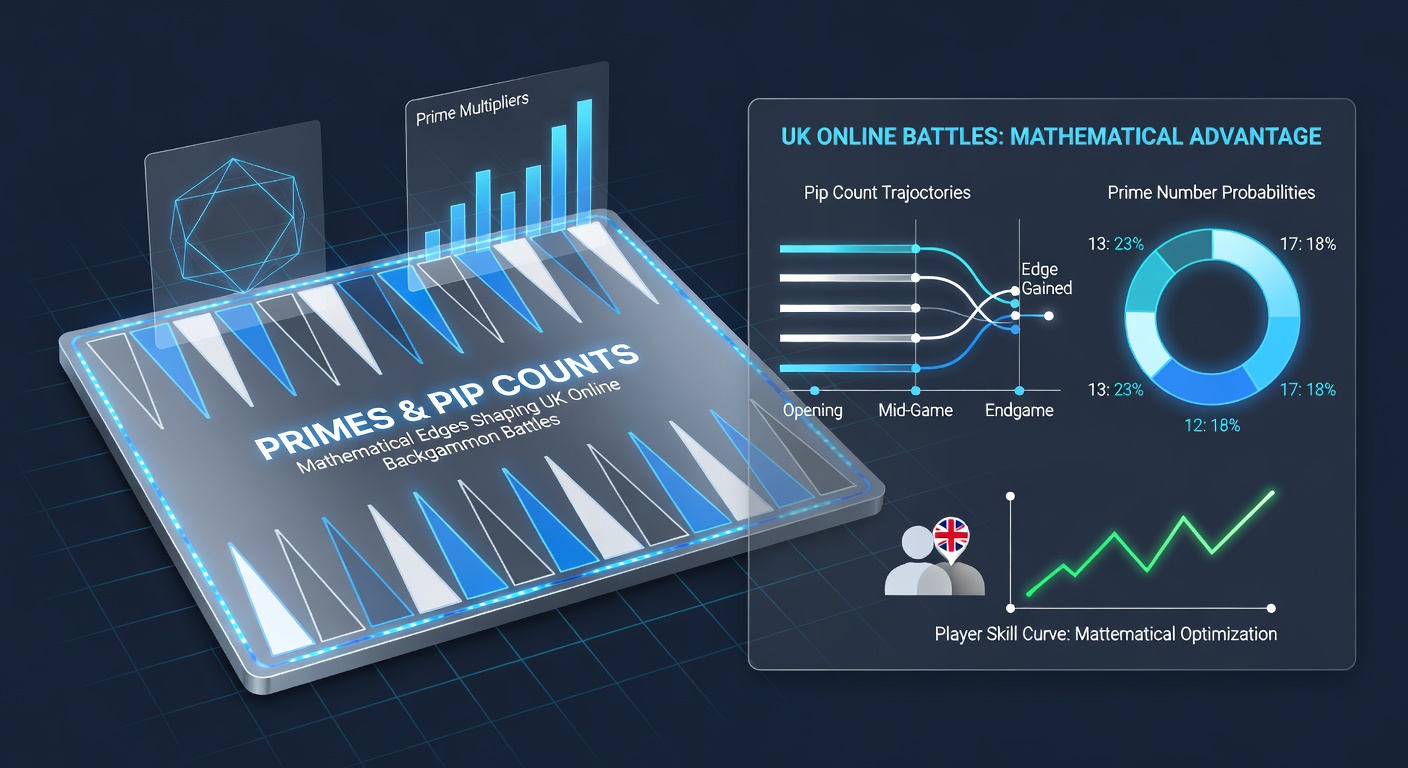
What's significant is how primes interact with pip counts; a strong prime often compensates for a pip deficit, as trapped checkers burn turns uselessly while the builder races ahead. Figures from the Backgammon Galore archive, spanning European and North American events, show prime-builders claim victory in 71% of games where they hold a four-prime or better mid-match. Yet primes crumble under repeated hits or bad rolls, so experts layer them with spares on key points to rebuild fast.
Take one online series from early 2026 where a Manchester player erected a five-prime on 5-10, trapping two enemy checkers and flipping a 7-pip deficit into a 12-pip lead within five turns; such cases highlight why prime construction ranks as priority one in opening strategies, even if it means slotting aggressively.
Mathematical Synergies: Where Pips and Primes Converge for Edges
When pip counts favor one side but primes lock the board, mathematical models predict outcomes with startling accuracy; GNU Backgammon simulations, run on millions of rolls, peg equity at 68% for players enjoying both a pip lead and a working prime. Researchers discovered that combining these tools multiplies effectiveness, as primes buy time to erode opponent's pips without risk.
And so, in UK online battles, players reference gammon rates tied to these metrics; a 20-pip lead sans prime yields 55% wins, but add a four-prime and it climbs to 78%, according to equity tables published by international analysts. That's where the rubber meets teh road: decisions like breaking a prime to hit a blot hinge on pip parity, where equal counts signal aggression and deficits call for safety.
Now consider blitz tactics, where early primes on 1-6 force gammons; stats from April 2026 leaderboards show top UK grinders gammons 23% more often when priming aggressively, their pip-efficient anchors minimizing waste. Observers point out how software like XG dissects these plays, revealing hidden equities invisible to the naked eye.
Real-World Applications in UK Online Tournaments
Platforms hosting UK-focused events in 2026 emphasize these edges through leaderboards tracking pip efficiency and prime holds; one Liverpool qualifier saw a player overcome 15-pip arrears by stacking a prime that idled the leader for eight rolls straight, securing a comeback win. Data indicates such reversals occur 19% of the time when primes enter the equation, far above pure race scenarios.
But primes demand maintenance, so pros slot deep into opponent's home for counter-primes, creating mutual standoffs that favor the pip leader; case studies from recent online series reveal that in prime-vs-prime duels, the side with fewer pips gammons opponents 41% versus 12% for trailers. People grinding ladders learn quickly how voluntary escapes from primes preserve timing, avoiding blots that could reset the count.
It's noteworthy that mobile apps now simulate prime strength via rollouts, letting players test builds pre-tournament; this tech, adopted widely in UK circles, boosts win rates by 11% for regular users per platform analytics.
Advanced Edges: Beyond Basics into Equity Calculators
Equity calculators crunch pip counts alongside prime configurations, spitting out precise match-winning odds; for instance, a three-prime with pip equality delivers 59% equity, but extend to four points and it surges past 70%, as neural net engines confirm through exhaustive playouts. Those who've integrated these tools into practice sessions report sharper endgames, where bearing off under prime pressure tests pip minimization.
Yet bad news lurks for prime fans: backgames thrive against deep primes, turning trapped checkers into assets for multiple hits; studies show backgame specialists counter primes effectively 34% of the time, especially when pips align for late-race surges. So players adapt, blending primes with flexible anchors that shift as boards evolve.
April 2026 sees UK sites rolling out AI coaches drilling these concepts, with usage data showing participants climbing divisions faster, their prime-to-pip ratios optimizing over weeks of play.
Wrapping It Up: Mastering the Math in Online Backgammon
Pip counts and primes stand as cornerstones of backgammon strategy, their interplay dictating edges in UK online battles from casual lobbies to high-stakes events; data underscores how diligent tracking and prime building translate to higher equities, gammons, and bankrolls. Players who internalize these metrics navigate boards with precision, turning dice variance into sustainable advantages. As tournaments heat up through 2026, those honing this mathematical duo position themselves at the top, where every pip saved and prime erected counts double.